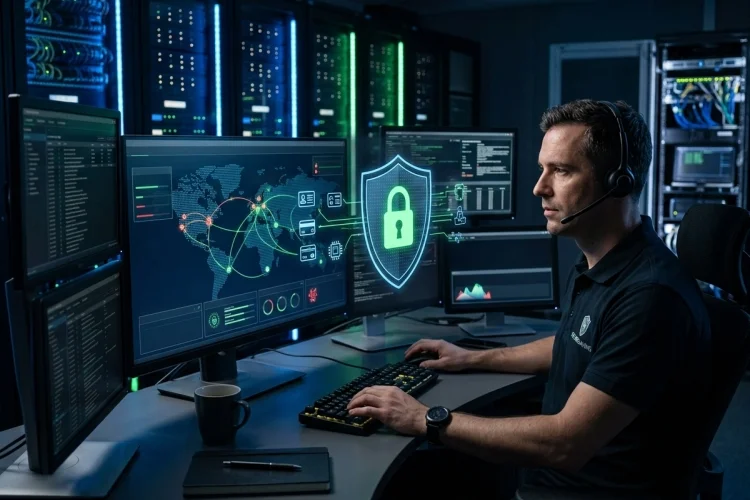
Creating an online casino account can involve sharing more information than many players realise. A platform may process your name, contact details, login credentials, payment information, transaction history, and identity documents.
Understanding How Online Casinos Protect Player Data therefore matters just as much as understanding the games themselves.
Regulated operators typically need a combination of encryption, authentication, access controls, payment security, monitoring, and internal policies to reduce the risk of data theft or unauthorised access.
No security system is perfect, but several layers can make sensitive information considerably harder to compromise.
Encryption Protects Data Moving Across the Internet
One of the most important protections is encryption.
When information travels between your browser and a casino server, encrypted connections help prevent outsiders from easily reading intercepted data.
Modern websites normally use HTTPS with TLS encryption. The UK Information Commissioner’s Office recommends using encrypted communications such as HTTPS when personal information is transmitted online and says outdated SSL versions should no longer be used.
This is particularly important when you enter passwords, personal details, or payment information.
Encryption transforms readable information into a form that requires the correct cryptographic key to interpret.
However, HTTPS alone does not prove that a casino is legitimate. A fraudulent website can also use encryption.
Players should still verify licensing and the exact website domain.
Stored Personal Information Can Also Be Encrypted
Protecting data while it travels is only half of the problem.
Casinos may also store account information in databases, backup systems, file servers, or other infrastructure.
Encryption at rest helps protect this stored information.
The ICO explains that encrypting stored personal data can reduce the risk of unauthorised access, particularly if a device or storage medium is lost or stolen.
For a casino, this could apply to databases containing customer records or other sensitive information.
Good encryption also requires secure key management.
If attackers steal both encrypted information and the keys needed to unlock it, the protection becomes much weaker.
That is why encryption should be part of a larger defence-in-depth strategy rather than treated as a complete security solution.
Authentication Protects Player Accounts
Encryption protects data, but casinos also need to verify who is trying to access an account.
The most familiar protection is a password.
Better systems can add multi-factor authentication, sometimes called MFA or 2FA.
MFA requires another form of verification beyond a password. This could include a code from an authentication app, hardware security key, or another approved factor.
NIST explains that passwords alone are often insufficient for protecting sensitive online systems and recommends multi-factor authentication as an additional security layer.
This becomes especially useful if a password is stolen through phishing or reused from another compromised service.
Not every casino offers the same authenication options, so players should check the account security settings themselves.
Using a unique password remains important even when MFA is available.
Casinos Limit Who Can Access Customer Information
Not every employee should be able to see every customer record.
Strong security systems therefore use access controls.
A customer-support agent may need access to basic account information but should not necessarily receive the same system privileges as a senior security administrator.
The ICO recommends limiting access to personal data to people who reasonably need it for their role. It also recommends stronger authentication for privileged users and maintaining appropriate audit trails.
This approach is commonly described as the principle of least privilege.
Access can also be removed when an employee changes roles or leaves the company.
These controls help reduce both accidental exposure and insider threats.
Well-designed systems keep sensitive information seperated according to business need rather than allowing unrestricted internal access.
Payment Information Has Extra Security Requirements
Casino payments create another category of sensitive information.
When card details are processed, payment companies and merchants may fall within the scope of the Payment Card Industry Data Security Standard, or PCI DSS.
PCI DSS provides technical and operational requirements for organisations that store, process, or transmit payment card data.
Strong cryptography can be used to make stored card information unreadable, while encryption is also required when applicable cardholder data travels across open or public networks.
Payment tokenization can offer additional protection.
Instead of exposing the underlying card number throughout different systems, a token can represent that information during certain payment processes.
This helps reduce the number of systems that need direct access to the original card data.
Gambling Regulators Can Set Security Requirements
Security is not purely optional for regulated gambling businesses.
The UK Gambling Commission’s Remote Gambling and Software Technical Standards include specific cybersecurity requirements for critical gambling systems.
These requirements apply to systems that record, process, store, share, transmit, or retrieve sensitive customer information such as authentication details, payment information, and account balances.
The Commission bases those controls on relevant sections of ISO/IEC 27001:2022.
That framework addresses areas such as information-security management, access controls, system protection, monitoring, and organisational safeguards.
Regulation does not make breaches impossible.
It does, however, establish security obligations that licensed businesses are expected to follow.
Monitoring Helps Detect Suspicious Activity
Good cybersecurity is not just about preventing attackers from getting inside.
Operators also need ways to recognise unusual activity.
Security systems may monitor failed login attempts, unexpected account access, unusual transactions, changes to passwords, and suspicious administrative activity.
Imagine an account normally accessed from one device suddenly receiving repeated login attempts from several locations.
That activity could trigger additional checks.
Internal monitoring is also valuable.
Audit logs can record who accessed particular systems, what actions were performed, and when configuration changes occurred.
The ICO’s security guidance emphasises appropriate audit trails and controls around access to systems processing personal information.
Effective monitoring helps security teams investigate incidents rather than discovering problems only after customers complain.
Backups Protect Against Data Loss
Cybersecurity also includes keeping information available.
A ransomware incident, hardware failure, software bug, or human mistake can make data inaccessible even when nobody has stolen it.
The UK GDPR security principle therefore extends beyond confidentiality.
The ICO explains that organisations should consider confidentiality, integrity, and availability. Systems should also be able to restore access to personal information following physical or technical incidents.
Secure backups can support this goal.
However, backups need protection too.
A poorly secured backup containing customer records can become another route for attackers.
Good maintainance therefore includes encryption, access controls, recovery testing, and secure backup management.
Security Testing Is an Ongoing Process
Cyber threats change continuously.
A system that was well protected several years ago may contain vulnerabilities today.
Casino operators therefore need ongoing updates, vulnerability management, security testing, and configuration reviews.
The Gambling Commission’s security standards are intended to reduce unnecessary security risks to remote gambling customers and apply security requirements to critical systems.
Data-protection guidance similarly says organisations should regularly test the effectiveness of their security measures and improve them when necessary.
This is why security should be viewed as an ongoing process rather than a certificate installed once when a website launches.
Updates and monitoring matter long after the casino goes live.
Players Still Have a Role in Account Security
Even a secure casino cannot completely protect an account if the player gives away the password.
Use a unique password and enable multi-factor authentication when available.
Avoid logging into financial accounts through suspicious links sent by email or messaging apps.
Also check the domain before entering credentials.
Do not share authentication codes with someone claiming to be customer support.
A genuine security system works best when both the operator and player protect their side of the account.
Security is a shared process, even though the operator remains responsible for protecting the systems and personal information it controls.
Understanding How Online Casinos Protect Player Data means looking beyond a padlock icon. Encryption, MFA, payment standards, access controls, monitoring, backups, and security testing all contribute to protecting sensitive information.
Before creating an account, verify the operator’s licence, inspect its privacy and security information, and use strong account protections yourself. Good security should involve several layers rather than one impressive-looking feature.