
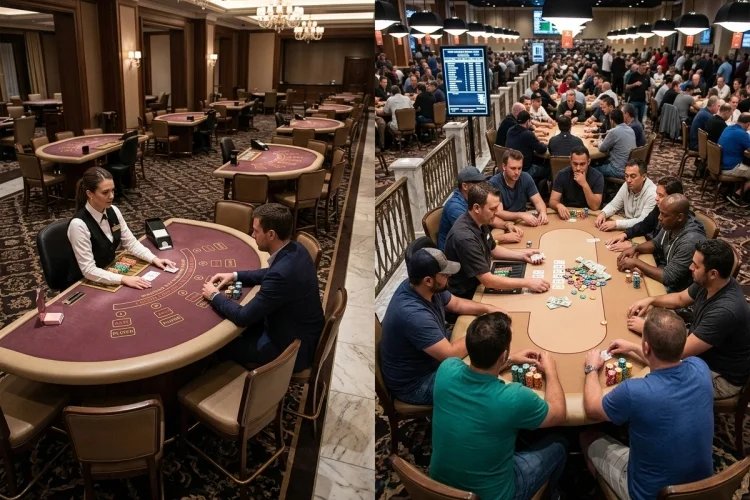
The word “poker” can describe two very different gambling experiences. One game may place you against a casino dealer, while another asks you to compete with several players for a shared pot.
Although both use cards and familiar poker hand rankings, their rules, costs, strategies, and winning conditions are not the same. Understanding casino poker vs player-to-player poker is therefore essential before joining a table.
Casino poker commonly refers to house-banked or dealer-facing games such as Three Card Poker and Casino Hold’em. Players make fixed wagers and try to beat the dealer or qualify for predetermined payouts.
Player-to-player poker includes formats such as Texas Hold’em and Omaha. The casino or online poker room organizes the game but normally does not compete for the pot.
Instead, it earns revenue through rake or tournament fees. This comparison explains how both categories work, where skill influences decisions, and which format may be easier for a beginner to approach.
What Is Casino Poker?
Casino poker is a group of table games that use poker-style hands but follow a structure similar to blackjack. Players usually compete against the dealer’s hand, a fixed paytable, or both.
Three Card Poker is a common example. A player can place an Ante wager, receive three cards, and decide whether to fold or make a Play bet. The dealer may need a qualifying hand before certain wagers are settled. Some versions also offer optional side bets such as Pair Plus.
The decisions are generally limited. Players may choose whether to continue, fold, or place an optional bonus wager, but they are not trying to bluff other participants.
What Is Player-to-Player Poker?
Player-to-player poker places participants against one another. Texas Hold’em, Omaha, Seven Card Stud, and many tournament formats belong to this category.
In Texas Hold’em, each participant receives two private cards and shares five community cards. Players can bet over several rounds and win either by reaching showdown with the strongest five-card hand or by convincing every opponent to fold.
The operator manages the software, cards, seating, and financial transactions. It usually earns a fee rather than relying on a built-in dealer advantage in each individual hand.
Who Are You Trying to Beat?
The main distinction is the opponent.
In casino poker, your primary objective is usually to beat the dealer or satisfy a fixed payout condition. The decisions made by other customers generally do not change the value of your hand.
In player-versus-player poker, every opponent matters. Their opening ranges, bet sizes, stack depths, position, and willingness to bluff can influence your decision.
This makes traditional poker more interactive. A pair that is strong against one cautious opponent may be less valuable after several players call a large raise.
How the Casino Earns Money
House-banked poker games contain mathematical rules that favor the operator over time. The exact advantage depends on the variant, strategy, paytable, and optional wagers.
Side bets frequently have different probabilities from the main game. Players should therefore read each paytable rather than assuming every wager offers similar value.
In peer-to-peer cash poker, the room generally collects rake. PokerStars describes rake as a fee charged for providing poker games, with the amount varying according to stakes, game type, and number of players. Some structures apply a maximum cap and take no rake when the hand ends before the flop.
Tournament operators usually charge an entry fee. For example, a listed buy-in of $10 + $1 commonly means $10 enters the prize pool and $1 is retained as the fee.
Strategy and Skill Requirements
Casino poker strategy usually focuses on following a clear decision threshold. In Three Card Poker, for instance, a commonly published approach is to continue with queen-six-four or better and fold weaker combinations.
Player-to-player poker requires a broader set of skills. Participants must evaluate starting hands, table position, bet sizing, pot odds, stack sizes, and opponent tendencies.
Bluffing is also meaningful in peer poker because another player may fold a stronger hand. Bluffing the dealer in casino poker is impossible because the dealer follows fixed procedures and does not react psychologically.
Game Speed and Social Interaction
Casino poker usually moves quickly. Every round has a simple sequence, and players make only a small number of decisions.
Peer-to-peer games may take longer because several people can raise, call, check, or fold during multiple betting rounds. Online tables add timers, but complex hands can still require careful thought.
Traditional poker also provides more direct competition. Players observe patterns, respond to changing table dynamics, and adjust their approach as opponents leave or join.
Risk, Variance, and Bankroll Control
Both formats involve financial risk, but losses can develop differently. Casino poker creates repeated wagers against fixed game mathematics, while player poker includes additional uncertainty from opponent skill and changing strategies.
Peer-to-peer players can experience long losing periods even when making reasonable decisions. Strong hands sometimes lose to unlikely draws, while tournament participants can be eliminated after one major pot.
Set a fixed entertainment budget before choosing either format. Responsible-gambling guidance recommends tools such as spending limits, regular breaks, time-outs, and self-exclusion when stronger controls are necessary.
Which Poker Format Is Better for Beginners?
Casino poker may be easier to learn because the betting process is short and dealer actions are predetermined. A beginner can understand the basic flow without analyzing several opponents.
Player-to-player poker may appeal to people who enjoy deeper strategy, competition, and long-term learning. However, it requires more patience and a stronger understanding of hand selection and position.
Neither option guarantees profit. The appropriate choice depends on whether you prefer simple dealer-based decisions or a more complex contest against other participants.
Casino poker and player-to-player poker may use similar cards, but they provide very different experiences.
Casino variants usually involve fixed bets against a dealer or paytable, while Texas Hold’em and Omaha require players to compete for pots and account for rake or tournament fees.
Choose casino poker when you prefer quick rounds and straightforward decisions. Select peer poker when you enjoy strategic adjustment, observation, and direct competition.
Before playing, study the complete rules, paytable, and fee structure, and verify that the operator is licensed in your location. Start with free practice or low stakes, establish firm spending limits, and treat every poker format as entertainment rather than guaranteed income.