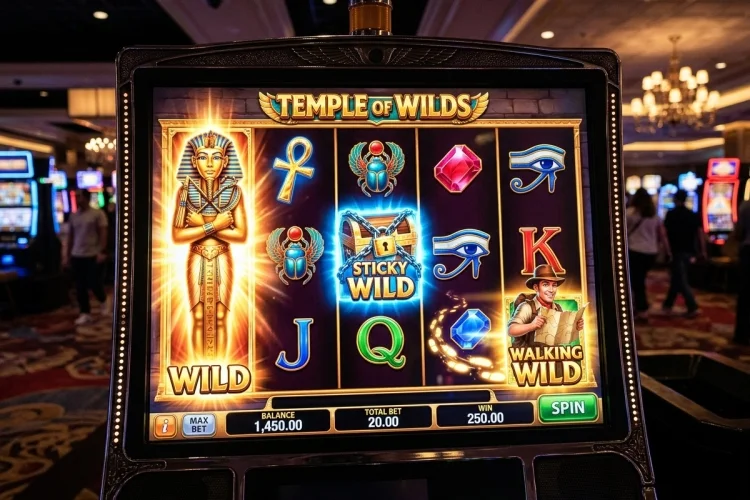

Every online slot spin lasts only a few seconds, yet the result comes from a detailed technical process. The reels, sounds, and animations are the visible layer.
In most regulated online slots, software has selected the outcome before the reel animation finishes. Understanding how online slot machines generate random results helps remove common myths.
A slot does not need to warm up, remember that one player has been losing, or schedule a jackpot because it has not appeared recently. A random number generator, usually called an RNG, produces numerical values that the game converts into reel positions and symbols.
Regulators and independent laboratories test this process for unpredictability, correct distribution, and secure implementation. Randomness does not mean every symbol has the same chance or that wins must appear regularly.
It means the next eligible result should not be predictable from earlier spins or adjusted according to an individual player’s recent results.
What Is a Slot RNG?
An RNG is hardware or software intended to produce statistically random values. Online slots commonly use software-based pseudorandom number generators, or PRNGs, which create long numerical sequences from an initial state known as a seed.
“Pseudorandom” does not mean easily predictable. NIST defines a PRNG as a deterministic process that uses seed inputs and produces values that appear random under specified tests. Secure designs make future output impractical to predict without access to the internal state.
What Happens After You Press Spin?
When a player presses spin, the game obtains RNG output according to its approved design. Because that output may cover a much larger range than the slot needs, the software converts it into values representing virtual reel stops.
Regulators describe this conversion as scaling. Mapping then connects the selected values to outcomes such as reel-strip symbols. The animation reveals those symbols, but it should not make another decision that changes the selected result.
Why Some Symbols Are Rarer
Uniform RNG output does not require every displayed symbol to appear equally often. The mathematical model decides how many possible values lead to each reel position.
Imagine a virtual reel with 100 positions. A low-paying symbol could occupy 20 positions, while a jackpot symbol occupies only two. Each position can be selected fairly, yet the jackpot remains much less likely.
This weighting shapes hit frequency, bonus triggers, prize sizes, RTP, and volatility. The paytable shows what combinations pay, while the mapping determines how frequently they can occur.
How RNG Systems Are Tested
A seed establishes the RNG’s starting state, so weak or repeated seeds could create predictable sequences.
The UK Gambling Commission says RNG streams should be unpredictable, should not repeat, and should not synchronize across separate instances. Seeding and scaling must not distort the intended probabilities.
Testing laboratories may review source code, inspect seed generation, produce large datasets, and apply statistical tests for bias, cycles, or correlation. eCOGRA describes certification as including code review, output analysis, seed evaluation, resistance testing, and periodic checks.
Regulators can also require formal reports before release. The UK Gambling Commission requires relevant remote licensees to submit game and RNG test results produced by an approved test house.
RNG, RTP, and Volatility
RNG selects an eligible result. Return to player, or RTP, describes the theoretical proportion of stakes returned as prizes over extensive play. Volatility describes whether those returns tend to arrive as frequent small prizes or rarer large ones.
A 96% RTP does not promise that a $100 session will return $96. The UK Gambling Commission notes that fully random games may require a million or more cycles before observed results approach their theoretical percentage.
Two slots can therefore use properly tested RNGs while offering different RTP figures and very different playing experiences.
Online slots generate results through a chain that begins with RNG output and ends with mapped reel positions, displayed symbols, and paytable-based settlement.
Seeding, scaling, virtual reels, and mathematical weighting allow the game to remain unpredictable while following its designed probabilities.
Independent laboratories and regulators test RNG systems for distribution, security, and resistance to prediction. Still, random results can contain long losing streaks, repeated symbols, or several wins close together.
Before playing, check the operator’s licence, read the paytable, review the stated RTP and volatility, and set a spending limit you can afford to lose. Treat every spin as an independent entertainment purchase, not as progress toward a guaranteed payout.