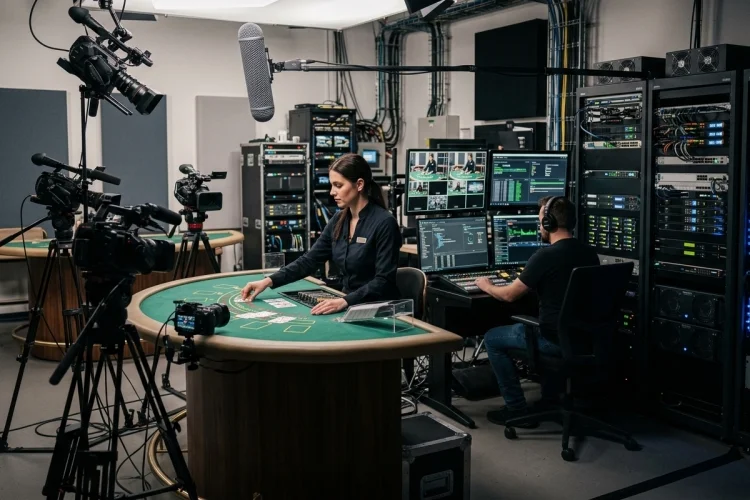

Watching live roulette or blackjack online can feel surprisingly straightforward. A dealer spins a wheel or deals physical cards, the result appears on your screen, and any winning wagers are settled automatically within seconds.
Behind that simple sequence is a much more detailed technical process. How Live Dealer Game Results Are Recorded involves physical casino equipment, video feeds, automated recognition systems, game servers, dealer supervision, and transaction logs working together.
nderstanding that process helps explain why live casino games can use real-world outcomes while still functioning like an online gambling product.
The Physical Event Creates the Original Result
In traditional live dealer games, the result normally begins with a real physical event.
A roulette ball lands in a numbered pocket. Blackjack cards are dealt from a physical shoe. In baccarat, actual cards determine the Player and Banker hands.
This is different from a standard digital casino game where software may use a random number generator to determine an outcome.
The UK Gambling Commission notes that live dealer games use physical equipment such as roulette wheels and card decks to produce results. It also highlights controls around equipment, card shuffling, roulette-wheel integrity, and dealing procedures.
The digital system therefore needs a reliable way to translate that physical event into machine-readable information.
Cameras Record More Than the Player Sees
The most visible technology in a live studio is the camera system.
Players receive a real-time video stream showing the dealer and gaming table, but surveillance has another purpose beyond entertainment.
Regulated live dealer environments may be required to record dealer activity clearly enough to verify whether dealing procedures and game rules were followed.
UK Gambling Commission standards also call for staff supervision and controls around secure gaming areas.
That means video can become part of the audit trail.
If something unusual occurs – a card is dealt incorrectly, a roulette ball behaves unexpectedly, or a round is disputed – recorded footage may help investigators reconstruct what actually happened.
The customer-facing stream and internal surveillance setup are not neccesarily identical, but both contribute to the overall technical environment.
Recognition Technology Turns Physical Results Into Data
The casino platform cannot settle thousands of online wagers by simply “watching” a video like a human viewer.
It needs structured data.
Gaming Laboratories International explains that physical actions in live dealer games can be translated into software-readable data using optical character recognition, or OCR, technology. This allows outcomes such as cards or roulette results to enter the digital gaming system.
Consider blackjack.
When a card is dealt, the recognition system can identify its value and transmit that information to the gaming platform. The software can then update the player’s screen, calculate the hand total, and determine which actions remain available.
Roulette works on the same broad principle: the physical wheel creates the outcome, while the result must be converted into digital information that the platform can process.
Different suppliers may use different techncial equipment, so the exact implementation is not universal.
A Control Server Connects Wagers With Each Round
Recording the winning number or card values is only one part of the job.
The platform must also know which bets belong to which round.
Regulations governing live table-game simulcasting in New Jersey require a control server to record wagering activity and game results. The same rules require dealer-verified results to be recorded before posting and provide a mechanism for voiding a result when necessary.
Pennsylvania regulations contain similar requirements for live studio simulcasting.
In practical terms, the system needs to associate each round with data such as the betting period, accepted wagers, final outcome, and settlement.
This is why live games have clear betting windows.
Once wagering closes, later bets should not simply be added after the outcome becomes known.
Dealer Verification Adds a Human Check
Automation is useful, but live dealer systems cannot assume recognition technology will never make a mistake.
A card could be misread. A physical object might temporarily block the camera. Equipment might produce an ambiguous reading.
This is where human verification becomes important.
Certain regulatory models explicitly require the result to be dealer-verified before it is posted to players.
A dealer, game supervisor, or authorised operator may therefore confirm or correct information according to the studio’s approved procedures.
This does not mean employees can casually change a result whenever they want. Live dealer operations are expected to be auditable, and controls surrounding staff activity and game records are designed to make unusual interventions reviewable.
The combination of automation and supervision provides an extra layer of verfication.
The Result Triggers Automatic Settlement
Once the final result is accepted by the gaming system, the next step is settlement.
The platform compares the recorded result with all valid wagers attached to that round.
Suppose a roulette wheel lands on 17.
The software can identify wagers on straight-up 17, the relevant colour, odd/even category, dozen, column, and other qualifying bets. Winning amounts are then calculated according to the published payout rules.
UK Gambling Commission standards state that reasonable steps should be taken to ensure bets are accepted, processed, and settled according to the operator’s published rules and the rules of the specific game.
The same principle applies to blackjack and baccarat.
The physical event determines what happened; the digital platform calculates the financial consequence for each online account.
Game Logs Create a Permanent Audit Trail
A properly operated live casino does not simply display a result and forget about it.
Game records are retained.
UK Gambling Commission guidance says live dealer game logs should be maintained and game events should be collated into statistics that can be analysed for trends involving performance, staff, or gaming locations.
Stored information can also support longer-term integrity monitoring.
For example, regulators note that roulette outcomes can be analysed over extended periods to see whether their distribution appears acceptably random. This information can be measured because results are held in databases.
That makes the game history useful for much more than showing players their last few results.
It can support compliance reviews, operational monitoring, technical investigations, and dispute handling.
What Happens When Something Goes Wrong?
Live gaming introduces physical and digital failure points.
A card might be exposed incorrectly. A stream may disconnect. Recognition technology could misread a result, or a system fault could interfere with settlement.
The response depends on the published game rules and the nature of the problem.
A round may sometimes be corrected, reviewed, or declared void. The important principle is that the operator should not simply invent a result after the fact.
UK Gambling Commission standards require faults affecting customers to be addressed and incorrectly settled bets to be corrected as soon as practical. Customers should also be informed when relevant errors affect them.
Video footage, transactional data, game logs, and supervisor records can all become relevant during such an investigation.
This layered evidence is what makes a live studio independently auditable rather than relying entirely on one person’s memory.
How Live Dealer Game Results Are Recorded involves much more than streaming a dealer to a website. Physical equipment creates the outcome, recognition systems digitise it, human checks confirm it, and servers connect it with player wagers.
Before playing, review the game’s rules and transaction history options. A well-regulated live casino should have clear procedures for recording, settling, and investigating every round.